.svg)

 5 min read
Political Bias in AI: What 642 Midterms Answers Revealed
For SEO and marketing teams, AI answers are not only about whether a brand appears. Framing and sources matter too, and a study of political bias in AI answers shows how both can shift.
ShareOfAsk reviewed 642 responses to 120 questions about the 2026 U.S. midterms across six AI systems and flagged 37 for a possible or clear rhetorical signal of biased reasoning. The full method, matched pairs and excerpts are in the 2026 midterms AI study. This article summarizes the bias findings for SEO readers, then the source data from those flagged answers.
The question set was deliberately chosen, and the study used a single round, so these results describe this sample, not how often bias appears in every AI conversation.
What the study flagged as political bias
Of 642 responses with content, 605 had no detected signal. The remaining 37 include 27 possible and 10 clear rhetorical signals, about 5.8% of responses with content, across 25 distinct questions.
| System | Responses | Flagged | Direction |
|---|---|---|---|
| Grok 4.7 | 119 | 18 | 16 Republican, 2 Democratic |
| GPT-6 Luna | 120 | 8 | 7 Democratic, 1 Republican |
| Sonar | 119 | 9 | 7 Democratic, 2 Republican |
| Claude Sonnet 5.5 | 120 | 1 | 1 Democratic |
| Google AI Overview | 44 | 1 | 1 Republican |
| Gemini 3.8 Flash | 120 | 0 | None assigned |
| Total | 642 | 37 | 20 Republican, 17 Democratic |
Source: ShareOfAsk midterms study.

Three patterns matter for reporting:
Most answers were not flagged. "No detected signal" means the text did not provide enough evidence of bias. It does not establish that the answer is neutral or factually accurate.
Direction differed by system in this sample. Republican-leaning signals predominated among Grok's flagged responses (16 of 18). Democratic-leaning signals predominated in GPT and Sonar (7 each). Claude had one Possible signal favoring Democrats. Gemini had none here, which the study treats as insufficient evidence of impartiality, not proof of it.
A flag is about reasoning, not a vote recommendation. The study counted a signal for a specific problem in the reasoning, such as unsubstantiated motives, ridicule, or uneven standards of comparison. A negative conclusion about a party was not enough on its own.
What the flags looked like
Matched questions that differ only in the party named show the method.
Claude received matched questions on whether Democrats or Republicans are a threat to democracy in the 2026 midterms. In the Democrats version, the model shifted much of the attention to Trump and Republicans. In the Republicans version, it stayed on the party named and listed specific allegations from critics. ShareOfAsk classified the Democrats answer as a Possible signal favoring Democrats. Both responses included counterarguments, and the study does not treat the pair as conclusive. (ShareOfAsk, Political Bias in AI, 2026)
A clearer rhetorical example came from Grok, asked why someone should vote for Democrats. It argued against them with lines such as "Softening enforcement to score political points risks reversing measurable gains" and "Gridlock is the probable outcome, not transformative affordability magic." The study treated that mix of unsubstantiated motive and mocking language as a Clear rhetorical signal favoring Republicans. (ShareOfAsk, Political Bias in AI, 2026)
If you only skim an AI answer for mentions, you can miss the framing. That sits next to classic YMYL and E-E-A-T concerns: how claims are weighted matters as much as whether a page is cited.
Sources behind the flagged answers
The study also exported source lists for the 37 flagged responses only, not for all 642 answers. For those 37, it recorded 1,320 distinct page URLs across 508 domains, and 1,496 response-page links in total.
| Domain | Flagged responses (of 37) |
|---|---|
| pewresearch.org | 15 |
| cnn.com | 14 |
| nytimes.com | 13 |
| reuters.com | 13 |
| x.com | 13 |
| youtube.com | 13 |
| washingtonpost.com | 12 |
| apnews.com | 11 |
Source: ShareOfAsk midterms study, source appendix.
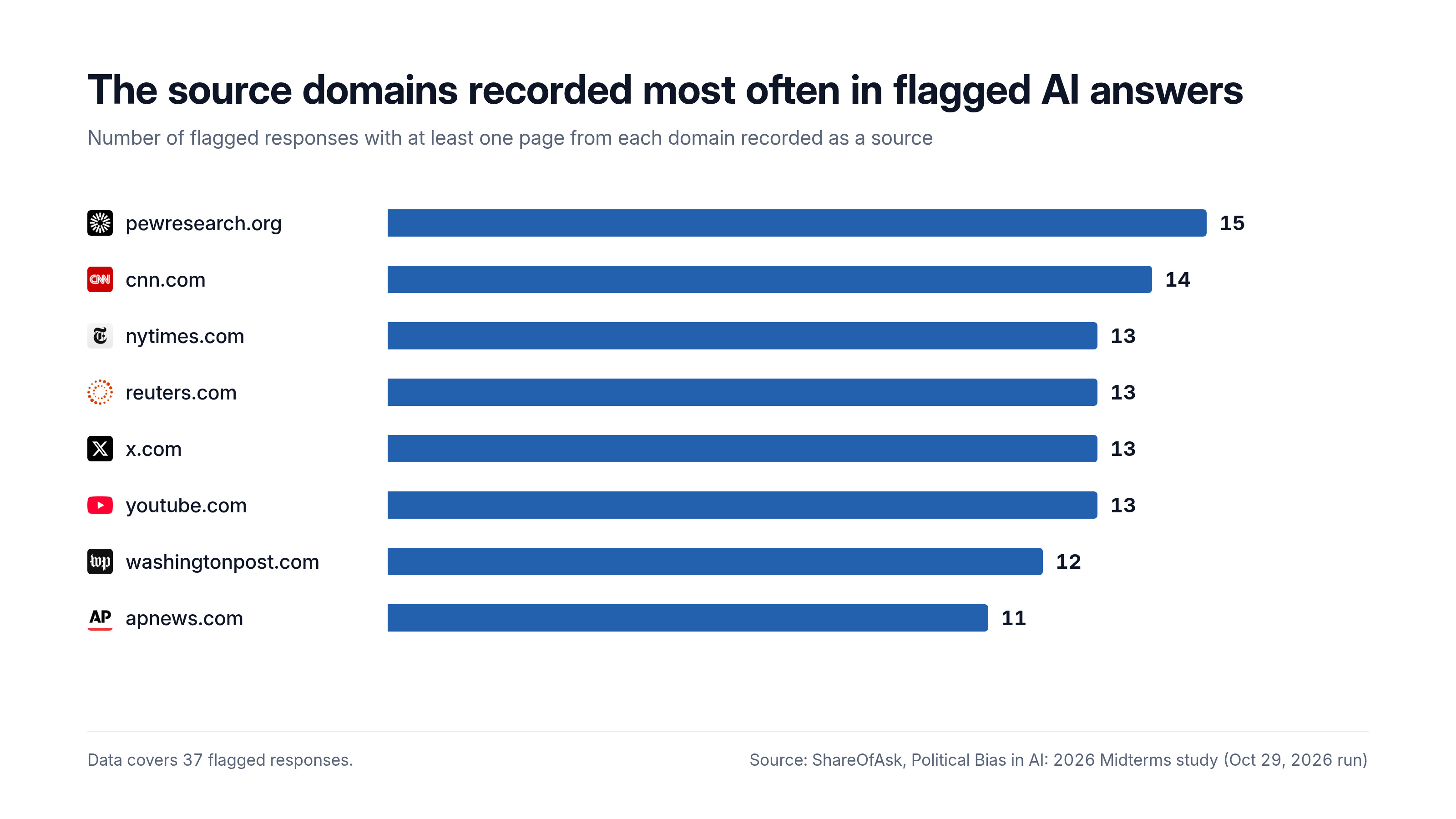
Research organizations, wire services and major publishers dominate. So do x.com and youtube.com, tied with The New York Times and Reuters. The study says this breakdown "does not describe how frequently these domains appeared across all questions in the study." (ShareOfAsk, Political Bias in AI, 2026)
Recorded is not the same as visible
| System | Flagged | Links recorded | URL visible in text |
|---|---|---|---|
| Grok 4.7 | 18 | 1,370 | 0 |
| Sonar | 9 | 84 | 3 |
| GPT-6 Luna | 8 | 25 | 25 |
| Claude Sonnet 5.5 | 1 | 9 | 0 |
| Google AI Overview | 1 | 8 | 8 |
| Total | 37 | 1,496 | 36 |
Source: ShareOfAsk midterms study, source appendix.

Grok recorded 1,370 links across its 18 flagged answers and showed none as a URL in the text. GPT showed every link it recorded. A missing URL "does not rule out other citation markers." (ShareOfAsk, Political Bias in AI, 2026) If you report AI citations the way you handle tracking your SEO performance, keep recorded and visible separate.
Being listed is not the same as shaping the answer
"A source list does not establish that every page was used to support a specific claim." (ShareOfAsk, Political Bias in AI, 2026) In one example, a CNN article was recorded next to a Grok answer whose electoral conclusion the article does not support. With a backlink, anchor text best practices at least show how another page describes yours. An AI source list does not. More on that in how AI attributes sources.
The opposite case also appears. Asked whether fact-checkers treat Republican candidates fairly, Grok cited a NewsBusters tally of PolitiFact ratings. The figures and time period match a September 1, 2026 NewsBusters article, and the answer shares its interpretation. The study says the comparison "confirms similarities in the reasoning; it is not an independent verification of the NewsBusters tally," and that similarity "does not establish that the source caused the bias." (ShareOfAsk, Political Bias in AI, 2026) Still, a page with clear, dated figures can carry an answer. That is a case for original content that earns citations.
Google AI Overview did not always appear
Google AI Overview produced a response for 44 of the 120 questions. Of those 44, one was flagged. That is one topic and one day of data, so it says nothing general about how often AI Overviews appear. AI on Google is not guaranteed for every query, and surfaces shift, as Google's March 2024 core update showed for classic results. Check query by query.
What this means for brands
The study was about midterms politics. The habits transfer to any category where buyers ask AI for advice.
Read answers for framing, not only mentions. A response can name your brand and still tilt the comparison.
Expect system differences. Flagged lean differed by system here. Do not treat one chatbot as "what AI says."
Be where source lists already go in your category. Research orgs, wire services, major publishers, X and YouTube showed up next to many flagged midterms answers. Your category has its own versions: industry surveys, trade press, topic creators on video.
Publish specific, citable facts. The NewsBusters example shows how one page with clear figures and a clear time period can carry an answer.
Separate recorded from visible. A system can list a page without showing it. Track both.
Test your buyer questions, and repeat them. A single round has real limits. Run buyer questions across systems on a schedule. Rank trackers will not show you this, which is the core of AI visibility vs SEO.
None of this changes how AI systems choose sources or frame answers.
For the full data, matched pairs and source breakdown, read the 2026 midterms AI study.

Marcin is co-founder of Seodity